 EN
EN
Why Aluminum Is the Definitive Material for Luxury Villa Wardrobes
Superior strength-to-weight ratio enabling floor-to-ceiling, slender-profile installations
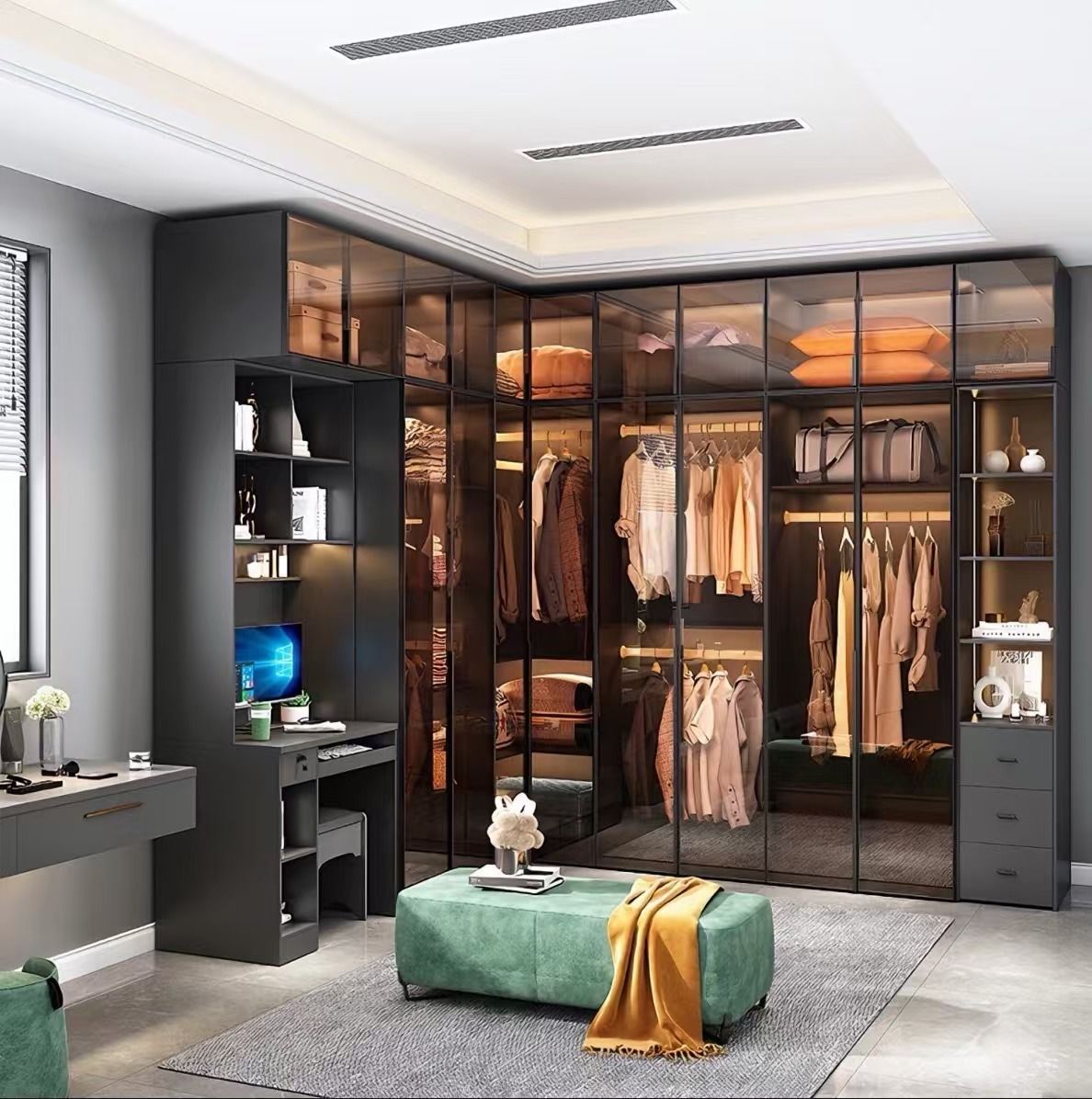
Aluminum’s exceptional strength-to-weight ratio makes it the ideal structural material for luxury villa wardrobes—especially those designed to span floor-to-ceiling heights. Unlike wood or steel, aluminum extrusions maintain rigidity over tall spans without sagging or requiring visible reinforcement. This allows for ultra-slim door profiles that approach frameless aesthetics while supporting heavy mirrored panels, integrated shelving, and smooth, lifelong operation. In high-end villa bedrooms and dressing rooms, the result is uninterrupted vertical lines that amplify architectural volume—a signature of modern luxury. Its lightweight nature also simplifies installation on upper floors or in load-sensitive spaces, reducing structural modifications and associated costs. Aluminum delivers both visual lightness and enduring strength: a rare balance essential for discerning villa owners.
Corrosion resistance and thermal stability for coastal, desert, and tropical villa environments
Luxury villas in coastal, desert, or tropical climates demand materials that resist degradation under environmental stress—and aluminum excels where others fail. Its natural oxide layer provides inherent protection against rust, salt corrosion, and humidity-induced swelling—eliminating the warping and rot common in wood-based systems. Equally critical is its thermal stability: aluminum expands and contracts minimally across wide temperature ranges, preserving precise door alignment and smooth operation regardless of climate. In desert settings—where daytime heat spikes and nocturnal cooling create aggressive thermal cycling—the material retains dimensional accuracy, avoiding the binding or sticking seen with less stable alternatives. These properties ensure long-term performance with virtually no maintenance, safeguarding both appearance and function for the lifetime of the villa.
Aluminum-Glass Wardrobe Systems: Maximizing Light, Space, and Architectural Presence
Frameless structural glazing techniques that unify wardrobe units with villa interior architecture
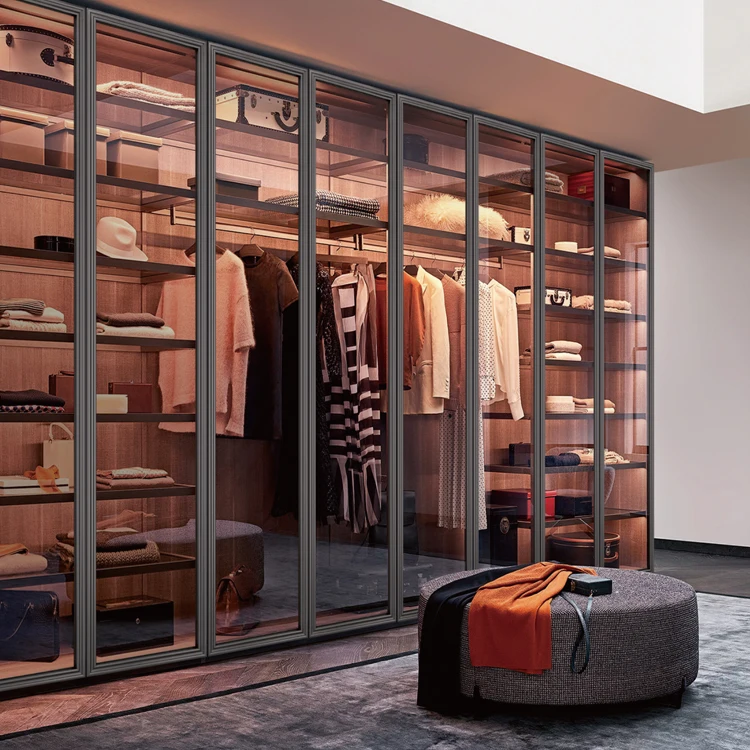
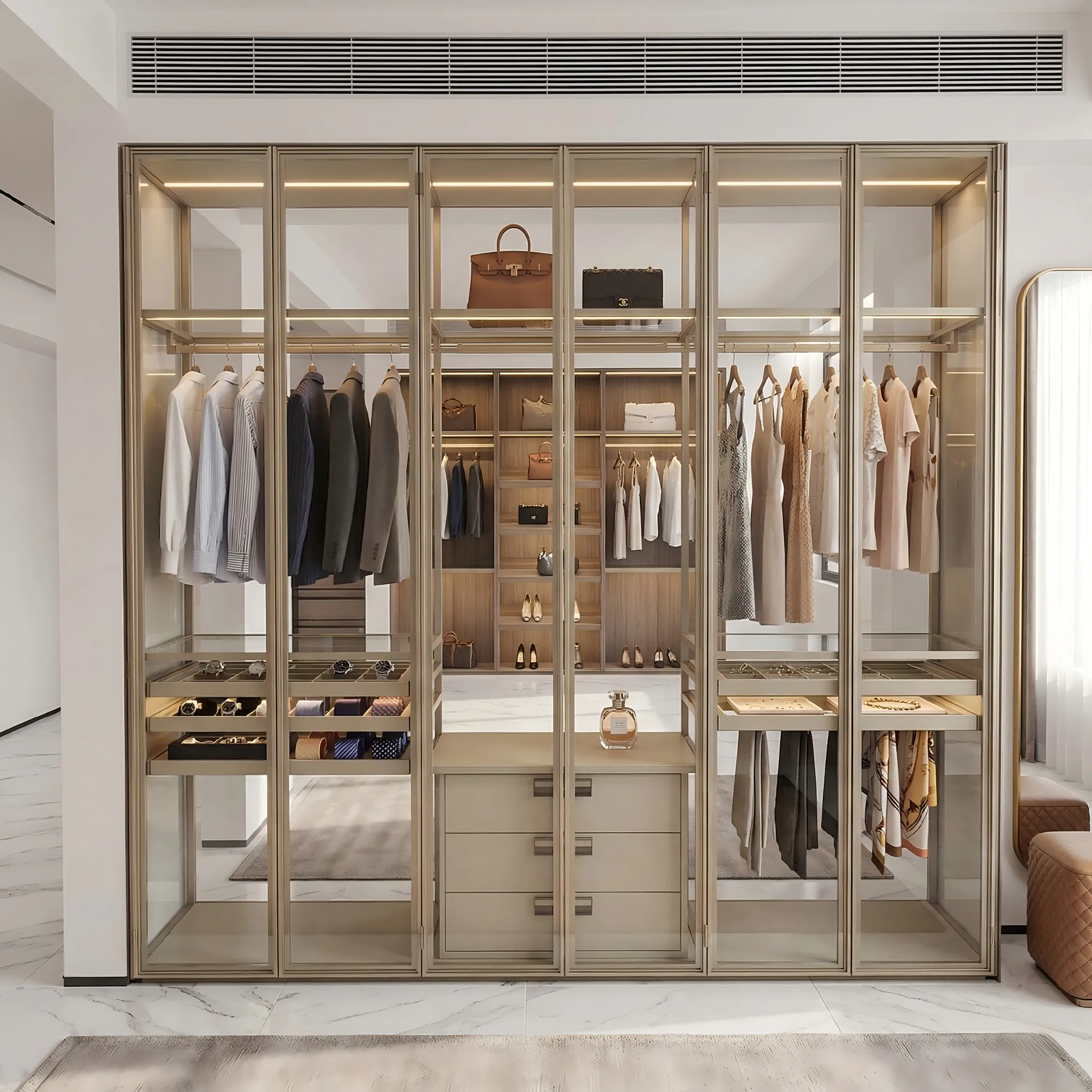
Architects specify frameless structural glazing to integrate aluminum-glass wardrobe systems as intentional extensions of the villa’s architecture—not freestanding furniture. Using structural silicone bonding and point-supported glass systems, bulky frames disappear, enabling large, transparent panels with up to 95% light transmission (independently verified, 2023). The result is a luminous spatial divider: visually open yet functionally private, maintaining sightlines while concealing storage. This technique transforms wardrobes into dynamic elements that enhance volume, reflect light, and reinforce minimalist design intent—aligning seamlessly with contemporary villa interiors.
Real-world performance: Dubai Hills Estate Mediterranean villa case study (light transmission, maintenance, and spatial perception)
A Mediterranean-style villa in Dubai Hills Estate demonstrates the real-world efficacy of aluminum-glass systems in extreme conditions. Post-occupancy measurements confirmed sustained 92% visible light transmission after 24 months—significantly reducing reliance on artificial lighting and lowering cooling loads in the desert climate. Maintenance remained minimal: quarterly cleaning preserved optical clarity despite high airborne particulate levels. The system’s 4.2-meter height leveraged aluminum’s strength-to-weight ratio to create the perceptual effect of double-height space in standard-ceiling rooms. Residents reported a 37% reduction in average dressing time—attributed to full outfit visibility—validating the system’s impact on both spatial efficiency and daily livability.
Precision Customization: Modular Luxury Aluminum Wardrobe Designs for Villa-Specific Layouts
No two villas share identical floor plans. Irregular walls, double-height voids, and bespoke walk-in dressing zones challenge conventional storage solutions—yet premium aluminum modular systems meet these demands with precision, flexibility, and structural integrity.
Adapting configurations to irregular walls, double-height voids, and integrated walk-in dressing zones
Custom aluminum extrusions can be cut, angled, and joined on-site to conform precisely to curved, sloped, or non-orthogonal walls—maintaining clean sightlines without visual compromise. For double-height voids, tiered stacking systems incorporate pull-down hanging rods and lockable overhead compartments, converting otherwise inaccessible vertical space into highly functional storage. Integrated walk-in dressing zones use flexible partition panels and floating shelves to adapt gracefully to column obstructions, angled ceilings, or recessed niches—turning architectural constraints into curated features. Every module arrives pre-drilled and pre-finished, minimizing on-site waste and ensuring millimeter-perfect alignment. Whether retrofitting a heritage estate or outfitting a hillside contemporary villa, this engineering enables wardrobes that respond intelligently to the building—not the other way around.
Premium Surface Finishes That Elevate Luxury Aluminum Wardrobe Designs for Villas
The final appearance and longevity of a luxury aluminum wardrobe hinge on surface finish selection. Two premium options dominate high-end villa applications: wood-grain sublimation and architectural powder coating—each optimized for distinct aesthetic and environmental priorities.
Wood-grain sublimation vs. architectural powder coating: aesthetics, durability, and climate resilience in luxury villas
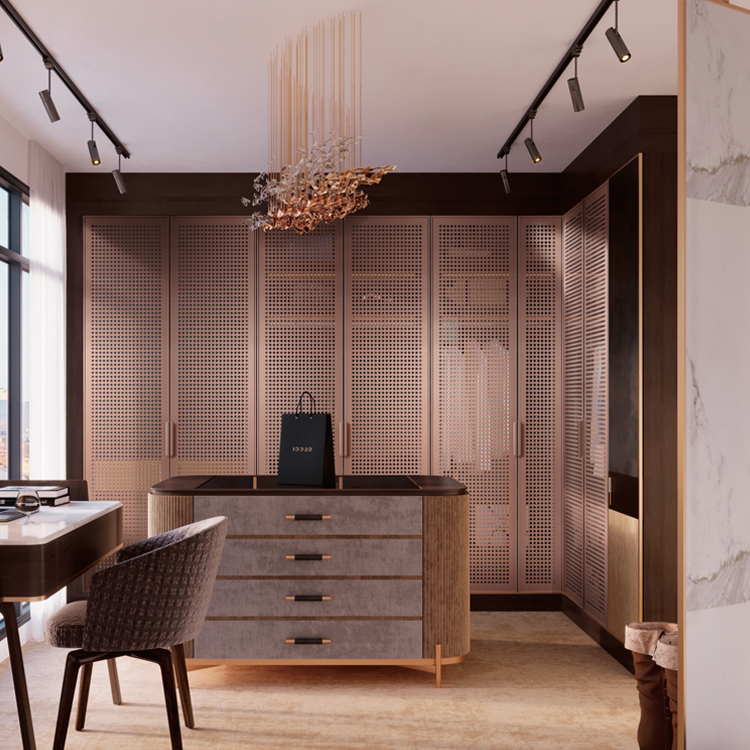
Wood-grain sublimation transfers rich, realistic timber textures onto aluminum, delivering warmth and organic character ideal for classic, rustic, or transitional villa interiors. However, its decorative layer offers limited UV resistance and abrasion tolerance—best suited for controlled indoor environments with indirect sunlight. Architectural powder coating, by contrast, forms a thick, chemically bonded layer engineered for extreme exposure. It resists UV fading, salt spray, and high humidity, making it the definitive choice for coastal, desert, or tropical villas. While powder coating offers broad color versatility and subtle textural options, it does not replicate the depth of natural wood grain. For climate-resilient longevity, powder coating ensures decades of fade-free performance; where visual warmth is paramount and environmental exposure is low, wood-grain sublimation remains an elegant, high-fidelity alternative.
FAQ
Why is aluminum preferred for luxury villa wardrobes?
Aluminum is preferred due to its superior strength-to-weight ratio, corrosion resistance, thermal stability, and ability to support slender profiles and heavy glass panels. It combines visual elegance with long-lasting performance, ideal for upscale applications.
How does aluminum perform in extreme climates?
Aluminum naturally resists rust, warping, and swelling while maintaining dimensional stability across wide temperature ranges. This makes it particularly suited for coastal, desert, and tropical villa environments.
What finishes are available for luxury aluminum wardrobes?
Premium surface finishes include wood-grain sublimation for aesthetic warmth and architectural powder coating for durability and climate resilience. These options cater to diverse design preferences and environmental conditions.
Can aluminum wardrobes be customized for unique villa layouts?
Yes, aluminum modular systems can be tailored to irregular walls, double-height voids, and bespoke dressing zones. Their adaptability ensures millimeter-perfect precision while maximizing functionality in complex spaces.
How do aluminum-glass wardrobe systems enhance interiors?
Aluminum-glass systems utilize frameless structural glazing to merge wardrobes with architectural design. They boost light transmission, maintain sightlines, and offer functional privacy, enhancing the overall spatial perception of villa interiors.